
Книги
Putnam
R.Davies
Airlines of the United States since 1914
20
R.Davies - Airlines of the United States since 1914 /Putnam/
The United States Air Mail Service
The Transcontinental Air Mail
Bearing in mind that the U.S. Mail service started operations six months before the end of the Great War, it was something of an achievement for the Post Office Department to have obtained money for such outlandish experiments as the New York - Washington venture. Air mail appropriations for both 1918 and 1919 were only $100,000, but by the end of 1919 more than $700,000 had been spent, once the inhibitions of war-time priorities had been relaxed. Late in 1918 the Post Office took over a large number of war-surplus aircraft, including over 100 de Havilland DH-4B biplanes, built under licence from the British company, with the important modifications of fitting Liberty engines and reversing the relative positions of pilot’s cockpit and fuel tank. With this substantial addition to its flying equipment, steps were taken to develop a transcontinental mail service.
The first segment of the route to be opened was the Chicago - Cleveland leg, on 15 May, 1919. This enabled 16 hr to be saved on the New York - Chicago mails, either by trans-shipping the load off the westbound train early in the morning at Cleveland, or by catching up with the train on its eastbound journey. Less than two months later, on 1 July, 1919, the New York - Cleveland segment was opened, and through mail service from New York to Chicago began on 5 September. Meanwhile, at the far end of the projected route, services were opened from San Francisco to Sacramento, on 31 July.
The following year, the long extensions were made to connect the two extremities, Chicago - Omaha on 15 May, 1920 - the Post Office likes to mark its anniversaries in fine style - and, finally, on 8 September, the first transcontinental link was forged, by inaugurating mail service over the difficult Rocky Mountain section of the route, via Cheyenne, Rawlins, and Rock Springs, Wyoming; Salt Lake City, Utah; and Elko and Reno, Nevada. The initial westbound trip averaged 80 mph and was flown without delays from any cause, mechanical, weather, or navigational. The aircraft carried 16,000 letters and saved 22 hours.
One of the features, incidentally, of the American railway system was that no single company provided a coast-to-coast route, and transfers, normally at Chicago, involved different stations, companies and lines of responsibility. Thus the aerial mail service gave the Post Office the advantage of continuous surveillance, in addition to the saving of time.
During 1920 two branch routes were also opened, Chicago - St Louis on 16 August, and Chicago - Minneapolis on 1 December; but both were discontinued on 30 June, 1921, soon after, and for the same reasons as the New York - Washington route.
For the first few months of operating the transcontinental route, flights were made only in daylight hours, with aircraft shuttling back and forth over allocated sections of the route, and mail loads being transferred at interchange stations. Acutely conscious that the full time-saving advantage of the mailplane over the train had not yet been demonstrated - and conscious too of criticism and doubt as to whether the effort was worth the expenditure of public funds - the administration decided to risk putting on a show before its term of office expired on 4 March, 1921. Accordingly, on 22 February, an attempt was made to fly the route continuously without interruption for darkness.
Four pilots set off, two from each of the coastal termini. Of the two who left New York, only one reached Chicago, where the weather was so bad that he, too, abandoned the trip. One of the two San Francisco aircraft crashed in Nevada, killing the pilot. The fourth flight made history. Frank Yeager took over the mail at Salt Lake City and flew through the night via Cheyenne to North Platte, handing it to Jack Knight, who took the load on to Omaha, where the aircraft to take over from him should have arrived from Chicago but was weatherbound there instead. Knight therefore flew on, helped by some bonfires to guide him across Iowa, and landed at Chicago early in the morning. Ernest Allison then had the comparatively easy task of delivering the transcontinental mails to New York, after a total elapsed time of 33 hr 20 min.
This was the breakthrough. One completed flight out of four attempted does not sound like an outstanding success. But consider the circumstances: February was hardly the best time of the year for minimizing the ratio of night/day flying. Lighting was hastily improvised. The daytime route had itself been in operation for less than six months. Aircraft were still unreliable.
But the Post Office was working on the last of these problems. It had issued a specification in April 1919 for a twin-engined aeroplane capable of carrying 1,500 lb of mail at 90 mph. Such was the infancy of the American aircraft industry at the time when the Post Office was desperate that not a single company came up with an acceptable design. The Post Office thereupon tried a design of its own, taking the DH-4 and fitting it with two Hall-Scott engines on the struts between the wings plus additional vertical stabilizers. Then it bought eight all-metal Junkers-F 13s from Germany. These clean-lined monoplanes, able to carry up to five passengers with only a 200 hp engine, showed great promise; but unfortunately a series of accidents, some fatal, cut short this line of interest.
During the fiscal year 1921, several different types were tried, and the Post Office Department paid manufacturers $476,000 for new and modified aircraft. On 1 July, 1921, however, this practice was discontinued and the mail fleet was standardized, the type selected being the de Havilland DH-4B. A large number was obtained from the War and Navy Departments and put through the Post Office’s own Air Mail Repair Depot at Chicago. Here, their fuselages were rebuilt, including metal mail containers providing increased mail stowage space; they were equipped with new undercarriages, with larger wheels; and the Liberty engines were improved to give more power and extra reliability.
The Transcontinental Air Mail
Bearing in mind that the U.S. Mail service started operations six months before the end of the Great War, it was something of an achievement for the Post Office Department to have obtained money for such outlandish experiments as the New York - Washington venture. Air mail appropriations for both 1918 and 1919 were only $100,000, but by the end of 1919 more than $700,000 had been spent, once the inhibitions of war-time priorities had been relaxed. Late in 1918 the Post Office took over a large number of war-surplus aircraft, including over 100 de Havilland DH-4B biplanes, built under licence from the British company, with the important modifications of fitting Liberty engines and reversing the relative positions of pilot’s cockpit and fuel tank. With this substantial addition to its flying equipment, steps were taken to develop a transcontinental mail service.
The first segment of the route to be opened was the Chicago - Cleveland leg, on 15 May, 1919. This enabled 16 hr to be saved on the New York - Chicago mails, either by trans-shipping the load off the westbound train early in the morning at Cleveland, or by catching up with the train on its eastbound journey. Less than two months later, on 1 July, 1919, the New York - Cleveland segment was opened, and through mail service from New York to Chicago began on 5 September. Meanwhile, at the far end of the projected route, services were opened from San Francisco to Sacramento, on 31 July.
The following year, the long extensions were made to connect the two extremities, Chicago - Omaha on 15 May, 1920 - the Post Office likes to mark its anniversaries in fine style - and, finally, on 8 September, the first transcontinental link was forged, by inaugurating mail service over the difficult Rocky Mountain section of the route, via Cheyenne, Rawlins, and Rock Springs, Wyoming; Salt Lake City, Utah; and Elko and Reno, Nevada. The initial westbound trip averaged 80 mph and was flown without delays from any cause, mechanical, weather, or navigational. The aircraft carried 16,000 letters and saved 22 hours.
One of the features, incidentally, of the American railway system was that no single company provided a coast-to-coast route, and transfers, normally at Chicago, involved different stations, companies and lines of responsibility. Thus the aerial mail service gave the Post Office the advantage of continuous surveillance, in addition to the saving of time.
During 1920 two branch routes were also opened, Chicago - St Louis on 16 August, and Chicago - Minneapolis on 1 December; but both were discontinued on 30 June, 1921, soon after, and for the same reasons as the New York - Washington route.
For the first few months of operating the transcontinental route, flights were made only in daylight hours, with aircraft shuttling back and forth over allocated sections of the route, and mail loads being transferred at interchange stations. Acutely conscious that the full time-saving advantage of the mailplane over the train had not yet been demonstrated - and conscious too of criticism and doubt as to whether the effort was worth the expenditure of public funds - the administration decided to risk putting on a show before its term of office expired on 4 March, 1921. Accordingly, on 22 February, an attempt was made to fly the route continuously without interruption for darkness.
Four pilots set off, two from each of the coastal termini. Of the two who left New York, only one reached Chicago, where the weather was so bad that he, too, abandoned the trip. One of the two San Francisco aircraft crashed in Nevada, killing the pilot. The fourth flight made history. Frank Yeager took over the mail at Salt Lake City and flew through the night via Cheyenne to North Platte, handing it to Jack Knight, who took the load on to Omaha, where the aircraft to take over from him should have arrived from Chicago but was weatherbound there instead. Knight therefore flew on, helped by some bonfires to guide him across Iowa, and landed at Chicago early in the morning. Ernest Allison then had the comparatively easy task of delivering the transcontinental mails to New York, after a total elapsed time of 33 hr 20 min.
This was the breakthrough. One completed flight out of four attempted does not sound like an outstanding success. But consider the circumstances: February was hardly the best time of the year for minimizing the ratio of night/day flying. Lighting was hastily improvised. The daytime route had itself been in operation for less than six months. Aircraft were still unreliable.
But the Post Office was working on the last of these problems. It had issued a specification in April 1919 for a twin-engined aeroplane capable of carrying 1,500 lb of mail at 90 mph. Such was the infancy of the American aircraft industry at the time when the Post Office was desperate that not a single company came up with an acceptable design. The Post Office thereupon tried a design of its own, taking the DH-4 and fitting it with two Hall-Scott engines on the struts between the wings plus additional vertical stabilizers. Then it bought eight all-metal Junkers-F 13s from Germany. These clean-lined monoplanes, able to carry up to five passengers with only a 200 hp engine, showed great promise; but unfortunately a series of accidents, some fatal, cut short this line of interest.
During the fiscal year 1921, several different types were tried, and the Post Office Department paid manufacturers $476,000 for new and modified aircraft. On 1 July, 1921, however, this practice was discontinued and the mail fleet was standardized, the type selected being the de Havilland DH-4B. A large number was obtained from the War and Navy Departments and put through the Post Office’s own Air Mail Repair Depot at Chicago. Here, their fuselages were rebuilt, including metal mail containers providing increased mail stowage space; they were equipped with new undercarriages, with larger wheels; and the Liberty engines were improved to give more power and extra reliability.
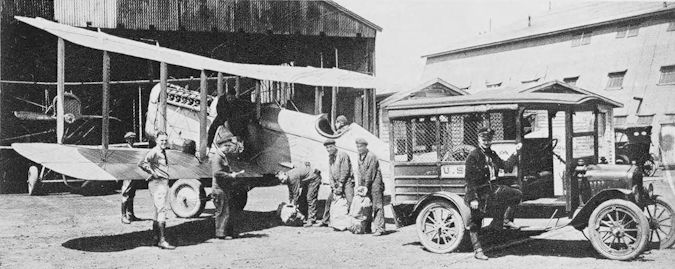
Mail being loaded into one of the Post Office’s large fleet of de Havilland DH-4Bs. The Ford mail van is worthy of study.
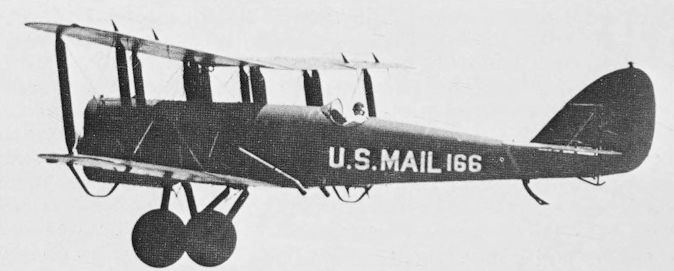
A rare flying view of a Post Office DH-4.
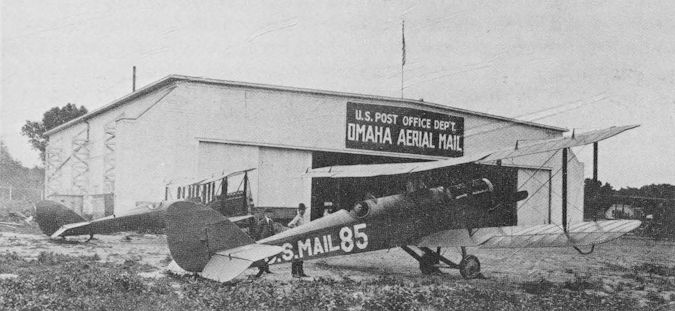
Two of the U.S. Post Office’s de Havilland DH-4s (before modification to DH-4B) at Omaha, Nebraska, in about 1920.
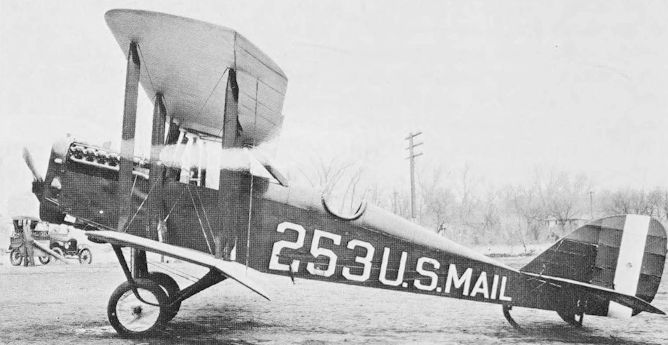
No. 253 was one of 135 de Havilland DH-4M2s built by Atlantic Aircraft Corporation (Fokker). This version had a gas-welded steel-tube fuselage and 110-gal main fuel tank. The example seen here was used by the Chicago - Omaha Division of the U.S. Post Office mail service.
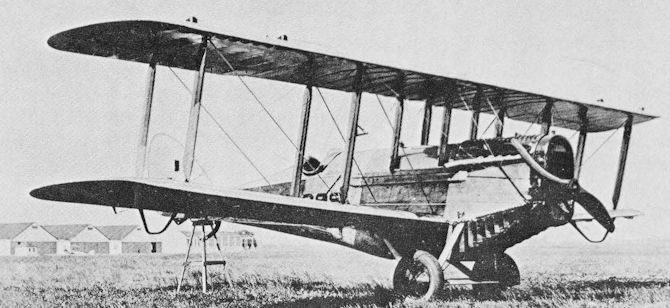
No.299 was a specially modified Post Office de Havilland DH-4B with much increased mail capacity in a deepened fuselage. It also had modified-section wings built by the Aeromarine company. In 1922 this aircraft carried a load of 1,032 Ib from New York to Washington.
The First Steps
Aeromarine
<...>
During the winter of 1920-21, Florida West Indies Airways (known later as Aeromarine West Indies Airways) began a successful experimental air mail service between Key West and Havana, having received a government Foreign Air Mail contract on 15 October, 1920. Aeromarine absorbed this operation, carrying passengers as a bonus, at $75 each. By this time the fleet had been augmented by some Curtiss F-5L flying-boats, big rugged dependable twin-engined biplanes, weighing seven tons fully loaded, and even when the payload was increased by Aeromarine’s 14-seat conversion - called Type 75 - had a cruising radius of four hours. Another carrier in this region was the America Trans Oceanic Company, which started service from Miami to the British island of South Bimini on 20 December, 1919, and operated one round trip daily for two full winter seasons, charging $25 return for the 50-mile flight.
<...>
The flight gave Aeromarine such a boost that it was able to establish, at the end of September, the High Ball Express service from New York to Havana, via Atlantic City, Beaufort (South Carolina), Miami, and Key West. F-5Ls were used, fitted with eight seats in the forward cabin and four in the rear. The journey took two days, compared with four days by rail and boat.
Then on 1 November, 1921, two regular daily services were inaugurated, from Key West to Havana and from Miami to Nassau. The Havana trip took 14-2 hr for the 105 miles, and cost $50 single, compared with $19 by steamer; the Nassau trip took 24-3 hr for 185 miles, and cost $85 single ($150 round trip), compared with $25 by steamer. These services operated throughout the winter and terminated on 1 May the following year.
Aeromarine then instituted a commendable scheduling practice, neatly mitigating the effect of the highly seasonal nature of the Florida traffic. The fleet was flown north and, on 1 June, 1922, began a Detroit - Cleveland service, providing a short cut across Lake Erie to avoid the circuitous surface journey via Toledo. The Ninety Minute Line, as it was called, maintained two round trips daily, taking 14 hr for the 95 miles, carrying passengers and baggage only, as Aeromarine had no mail contract for this route. The single fare was $25, compared with $9 by rail and $5 by steamer, both of which were much slower. The Cleveland - Detroit service ended on 1 October, when the fleet made its migration once again to the south.
During 1922 services were expanded and Aeromarine boasted three operating divisions: Southern: Key West - Havana, Miami - Nassau, Miami - Bimini, with special flights from New York to Havana; New York: New York - Atlantic City, New York - points in New England, New York aerial sightseeing; and Great Lakes: Cleveland - Detroit, sightseeing over Lake Erie and Lake St Clair, and special flights New York - Detroit, via Albany, Montreal, Buffalo, and Cleveland.
With this increased activity, however, Aeromarine appears to have over-reached itself, for in September 1923, after three years of regular scheduled service, it ceased operations. In spite of carrying some 17,000 passengers on scheduled services, and probably as many on sightseeing trips, with a perfect safety record, the company could not pay its way. Early in 1924 it was reorganized, with new capital, changing its name to Aeromarine Airways Corporation; but there is no record of systematic airline service from then on.
The Foreign Air Mail contract, from Key West to Havana - which the U.S. Post Office presumably designated FAM-1 at the time - lapsed with the demise of Aeromarine.
Aeromarine
<...>
During the winter of 1920-21, Florida West Indies Airways (known later as Aeromarine West Indies Airways) began a successful experimental air mail service between Key West and Havana, having received a government Foreign Air Mail contract on 15 October, 1920. Aeromarine absorbed this operation, carrying passengers as a bonus, at $75 each. By this time the fleet had been augmented by some Curtiss F-5L flying-boats, big rugged dependable twin-engined biplanes, weighing seven tons fully loaded, and even when the payload was increased by Aeromarine’s 14-seat conversion - called Type 75 - had a cruising radius of four hours. Another carrier in this region was the America Trans Oceanic Company, which started service from Miami to the British island of South Bimini on 20 December, 1919, and operated one round trip daily for two full winter seasons, charging $25 return for the 50-mile flight.
<...>
The flight gave Aeromarine such a boost that it was able to establish, at the end of September, the High Ball Express service from New York to Havana, via Atlantic City, Beaufort (South Carolina), Miami, and Key West. F-5Ls were used, fitted with eight seats in the forward cabin and four in the rear. The journey took two days, compared with four days by rail and boat.
Then on 1 November, 1921, two regular daily services were inaugurated, from Key West to Havana and from Miami to Nassau. The Havana trip took 14-2 hr for the 105 miles, and cost $50 single, compared with $19 by steamer; the Nassau trip took 24-3 hr for 185 miles, and cost $85 single ($150 round trip), compared with $25 by steamer. These services operated throughout the winter and terminated on 1 May the following year.
Aeromarine then instituted a commendable scheduling practice, neatly mitigating the effect of the highly seasonal nature of the Florida traffic. The fleet was flown north and, on 1 June, 1922, began a Detroit - Cleveland service, providing a short cut across Lake Erie to avoid the circuitous surface journey via Toledo. The Ninety Minute Line, as it was called, maintained two round trips daily, taking 14 hr for the 95 miles, carrying passengers and baggage only, as Aeromarine had no mail contract for this route. The single fare was $25, compared with $9 by rail and $5 by steamer, both of which were much slower. The Cleveland - Detroit service ended on 1 October, when the fleet made its migration once again to the south.
During 1922 services were expanded and Aeromarine boasted three operating divisions: Southern: Key West - Havana, Miami - Nassau, Miami - Bimini, with special flights from New York to Havana; New York: New York - Atlantic City, New York - points in New England, New York aerial sightseeing; and Great Lakes: Cleveland - Detroit, sightseeing over Lake Erie and Lake St Clair, and special flights New York - Detroit, via Albany, Montreal, Buffalo, and Cleveland.
With this increased activity, however, Aeromarine appears to have over-reached itself, for in September 1923, after three years of regular scheduled service, it ceased operations. In spite of carrying some 17,000 passengers on scheduled services, and probably as many on sightseeing trips, with a perfect safety record, the company could not pay its way. Early in 1924 it was reorganized, with new capital, changing its name to Aeromarine Airways Corporation; but there is no record of systematic airline service from then on.
The Foreign Air Mail contract, from Key West to Havana - which the U.S. Post Office presumably designated FAM-1 at the time - lapsed with the demise of Aeromarine.
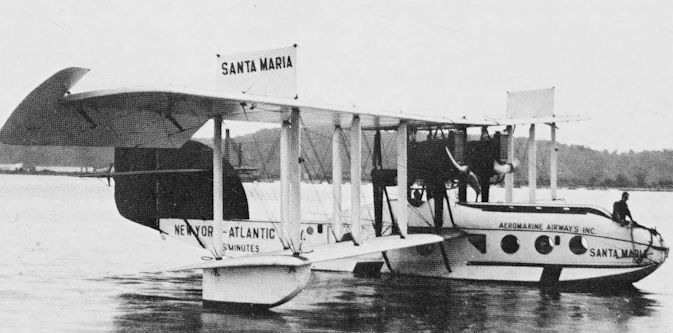
Aeromarine Airways’ Curtiss Type 75 flying-boat Santa Maria used on New York - Atlantic City and U.S. - Cuba services in 1921. This type was a 14-seat conversion of the military F-5L.
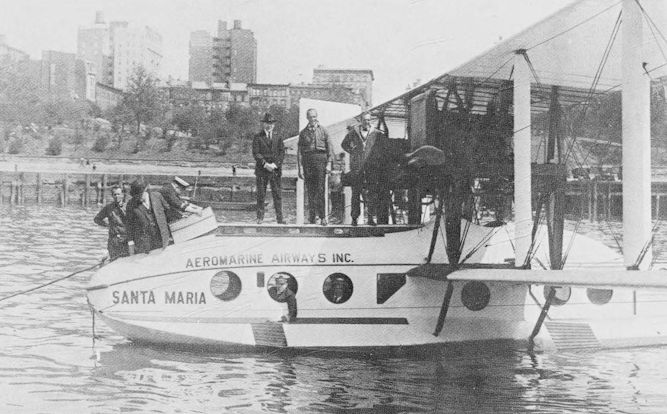
Close-up of the Curtiss 75 Santa Maria showing bow entrance hatch and walkway above the forward cabin.
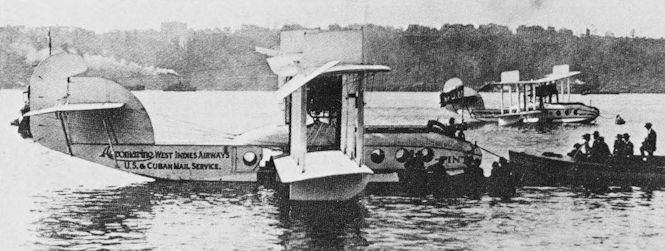
The Aeromarine West Indies Airways Curtiss 75s Pinta (nearest) and Santa Maria, used on the U.S. & Cuban Mail Service. This was the first international air mail service by a US airline, and presumably the original FAM-1 Post Office contract.
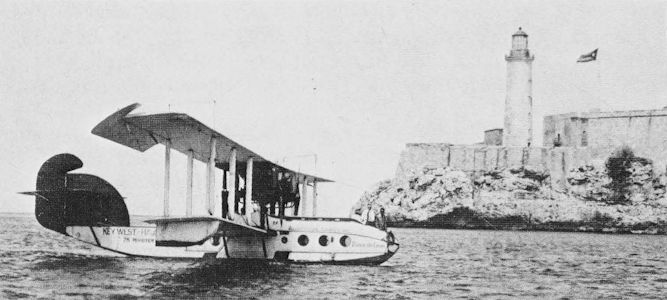
The Aeromarine Airways’ Curtiss 75 Ponce de Leon in Cuban waters in 1921. Painted on the hull are the words Key West - Havana 75 minutes.
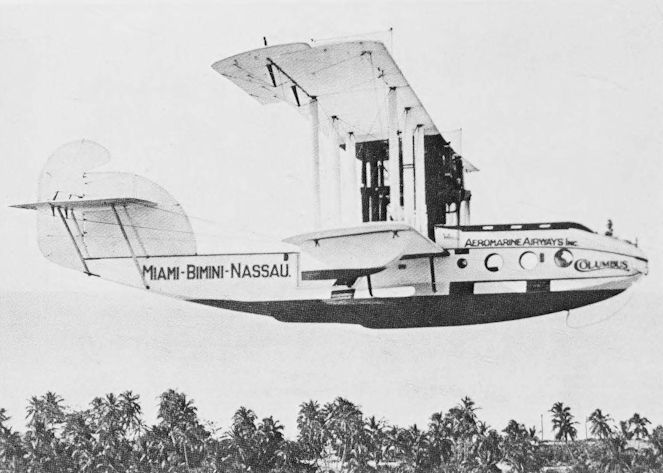
The route is boldly displayed on the hull of Aeromarine Airways’ Curtiss 75 Columbus.
The First Steps
St Petersburg - Tampa
On 17 December, 1913, exactly ten years after Orville and Wilbur Wright’s now undisputed claim to have made the first power-driven, heavier-than-air, controlled flight, the city of St Petersburg, Florida, signed a contract with Thomas Benoist, aircraft manufacturer of St Louis, Missouri, for the operation of an airline. Two weeks previously, on 4 December, the company had been organized as the St Petersburg-Tampa Airboat Line by Paul E. Fansler, an electrical engineer, with the backing of city officials and businessmen. On 13 December, a contract was signed with the city of St Petersburg for a subsidy guarantee amounting to $50 per day during the month of January and $25 per day during February and March.
Much of the credit must go to Benoist. He had founded his company in St Louis in 1909 after making a fortune in the motorcar business, and his ambition was to demonstrate that aeroplanes were more than instruments of sport or machines of war; that they could be used as a practicable means of transport on a regular basis.
The conditions at St Petersburg were ideal for proving his point. The city was then a fast-growing community of about 8,000 people whose nearest retail and wholesale centre was Tampa, separated from it by Tampa Bay. To reach the local metropolis, the choice was a once-daily boat which took two hours, a 12-hr railway journey, or an arduous drive over dirt roads which took the greater part of a day. Benoist and Fansler had a captive market for their new product, air transport.
Benoist’s aircraft selected for the task was the Type XIV flying-boat, 26 ft long, weighing 1,400 Ib, and with a wing span of 36 ft. It was powered by a 75 hp Roberts six-cylinder engine driving a pusher propeller, flew at about 70 mph, and cost $4,150. The pilot was Tony Jannus, to whom the prospects of flying a regular schedule on the flimsy craft of plywood, spruce, and linen, was just as attractive as the racing and aerobatics which comprised the major proportion of aviation activity at that time.
Regular flights started promptly at 10 a.m. on New Year’s Day, 1914, watched by most of the citizens of St Petersburg. The first passenger was ex-mayor A. C. Pheil, who paid $400 for the privilege. Subsequently passengers paid $5 for the single trip, and the same charge was made for 100 lb of freight. One interesting feature of this, the first regular airline tariff in history, was that an excess baggage charge of 5 cents per lb was made for passengers and baggage weighing more than 200 Ib, a remarkable similarity with the rates charged 50 years later.
This first airline flight in the world took 23 min from the St Petersburg Yacht Basin to the mouth of the Hillsboro River at Tampa, a distance of 18 miles. With a following wind, the return journey took only 20 min, a feature of the service which repeated itself to the point where the local St Petersburg newspaper remarked on the way folks seemed anxious to get away from Tampa.
Settling down to fulfilling a regular timetable, with two round trips a day, the St Petersburg-Tampa Airboat Line was able to repay $360 of its municipal subsidy in January and paid its own way in February and March. Late in January, passenger demand was such that a second, larger, flyingboat was put into service, flown by Tony Jannus’ brother, Roger, who also undertook charter flights to local resorts. When the contract with the city expired on 31 March, 1914, the world’s first airline had carried 1,204 passengers without mishap. Bad weather and mechanical breakdowns forced cancellations on only eight days. Repairs to both aircraft cost only $100.
Operations were continued during April, but the Mexican war scare, combined with the wane of the tourist season, led to a fall in business, and the service was terminated. As a postscript to this early airline adventure, three of the main participants died before the start of the next airline - Benoist was killed, ironically, in a tramcar accident in St Louis in 1917; Tony Jannus disappeared over the Black Sea while training Russian pilots at the end of World War 1; and his brother Roger was killed in an aeroplane crash on the Western Front.
St Petersburg - Tampa
On 17 December, 1913, exactly ten years after Orville and Wilbur Wright’s now undisputed claim to have made the first power-driven, heavier-than-air, controlled flight, the city of St Petersburg, Florida, signed a contract with Thomas Benoist, aircraft manufacturer of St Louis, Missouri, for the operation of an airline. Two weeks previously, on 4 December, the company had been organized as the St Petersburg-Tampa Airboat Line by Paul E. Fansler, an electrical engineer, with the backing of city officials and businessmen. On 13 December, a contract was signed with the city of St Petersburg for a subsidy guarantee amounting to $50 per day during the month of January and $25 per day during February and March.
Much of the credit must go to Benoist. He had founded his company in St Louis in 1909 after making a fortune in the motorcar business, and his ambition was to demonstrate that aeroplanes were more than instruments of sport or machines of war; that they could be used as a practicable means of transport on a regular basis.
The conditions at St Petersburg were ideal for proving his point. The city was then a fast-growing community of about 8,000 people whose nearest retail and wholesale centre was Tampa, separated from it by Tampa Bay. To reach the local metropolis, the choice was a once-daily boat which took two hours, a 12-hr railway journey, or an arduous drive over dirt roads which took the greater part of a day. Benoist and Fansler had a captive market for their new product, air transport.
Benoist’s aircraft selected for the task was the Type XIV flying-boat, 26 ft long, weighing 1,400 Ib, and with a wing span of 36 ft. It was powered by a 75 hp Roberts six-cylinder engine driving a pusher propeller, flew at about 70 mph, and cost $4,150. The pilot was Tony Jannus, to whom the prospects of flying a regular schedule on the flimsy craft of plywood, spruce, and linen, was just as attractive as the racing and aerobatics which comprised the major proportion of aviation activity at that time.
Regular flights started promptly at 10 a.m. on New Year’s Day, 1914, watched by most of the citizens of St Petersburg. The first passenger was ex-mayor A. C. Pheil, who paid $400 for the privilege. Subsequently passengers paid $5 for the single trip, and the same charge was made for 100 lb of freight. One interesting feature of this, the first regular airline tariff in history, was that an excess baggage charge of 5 cents per lb was made for passengers and baggage weighing more than 200 Ib, a remarkable similarity with the rates charged 50 years later.
This first airline flight in the world took 23 min from the St Petersburg Yacht Basin to the mouth of the Hillsboro River at Tampa, a distance of 18 miles. With a following wind, the return journey took only 20 min, a feature of the service which repeated itself to the point where the local St Petersburg newspaper remarked on the way folks seemed anxious to get away from Tampa.
Settling down to fulfilling a regular timetable, with two round trips a day, the St Petersburg-Tampa Airboat Line was able to repay $360 of its municipal subsidy in January and paid its own way in February and March. Late in January, passenger demand was such that a second, larger, flyingboat was put into service, flown by Tony Jannus’ brother, Roger, who also undertook charter flights to local resorts. When the contract with the city expired on 31 March, 1914, the world’s first airline had carried 1,204 passengers without mishap. Bad weather and mechanical breakdowns forced cancellations on only eight days. Repairs to both aircraft cost only $100.
Operations were continued during April, but the Mexican war scare, combined with the wane of the tourist season, led to a fall in business, and the service was terminated. As a postscript to this early airline adventure, three of the main participants died before the start of the next airline - Benoist was killed, ironically, in a tramcar accident in St Louis in 1917; Tony Jannus disappeared over the Black Sea while training Russian pilots at the end of World War 1; and his brother Roger was killed in an aeroplane crash on the Western Front.
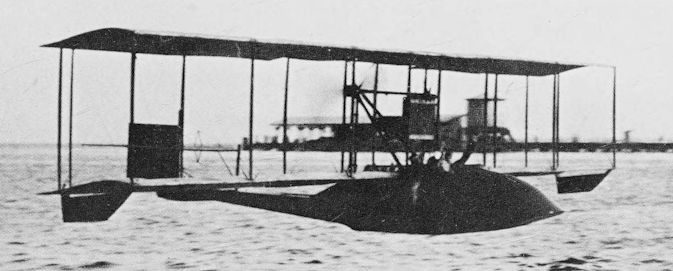
The Benoist Type XIV airborne on the world's first air route
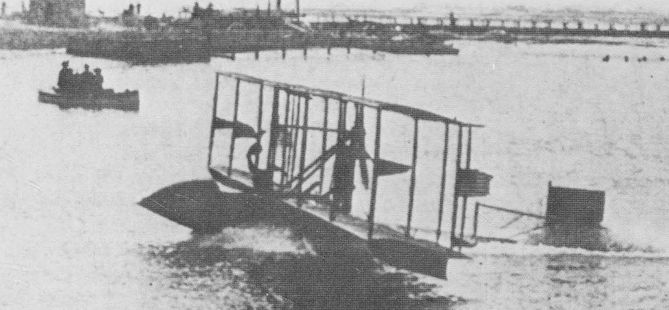
The Benoist Type XIV taxi-ing with flags flying from the interplane struts and Tony Jannus waving from the cockpit.
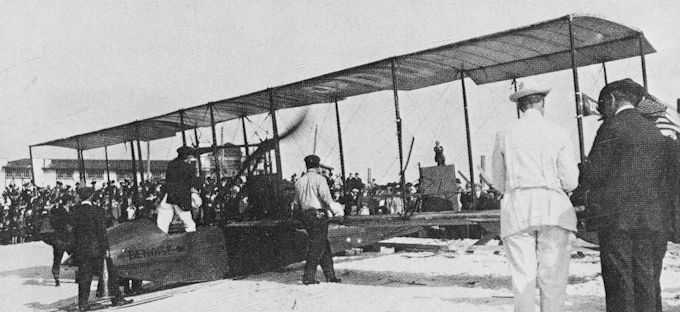
The first scheduled air service. The St Petersburg-Tampa Airboat Line’s Benoist Type XIV flying-boat on the rough plank slipway at St Petersburg just before the first flight to Tampa on 1 January, 1914
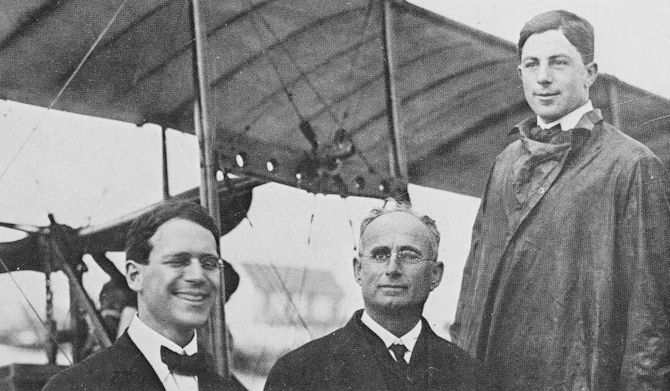
Left to right: Paul E. Fansler, organizer of the St Petersburg-Tampa Airboat Line; A. C. Pheil, the first passenger from St Petersburg to Tampa on 1 January, 1914; and Tony Jannus, the pilot of the world’s first scheduled air service.
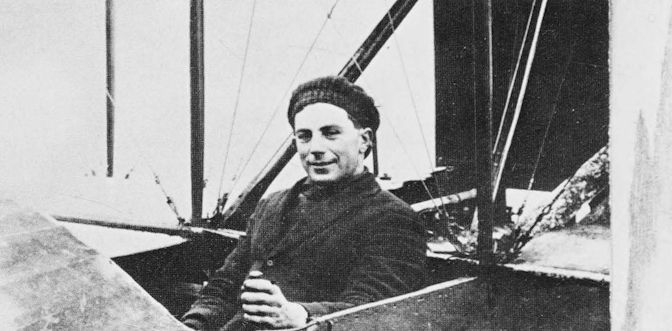
Tony Jannus in the cockpit of the Benoist Type XIV flying-boat.
The First Steps
Eddie Hubbard’s Airline
Inglis Uppercu’s company is given the credit in this book for operating the first post-war regular airline only after some considerable heart-searching on the part of the author. Aeromarine wins pride of place because of its greater frequency of operation, and the fact that it carried passengers over a network of routes. Judged on somewhat less demanding criteria, another operator, at the opposite side of the continent, can claim at least chronological parity, operating as it did a single route, for mail only, at a lower frequency, for a longer period than the eastern pioneer.
During the First World War Edward (Eddie) Hubbard had been an instructor to army pilots at Rockwell Field, San Diego, and in 1917 had become an experimental pilot for the Boeing company. On 3 March, 1919, he made a survey flight from Vancouver to Seattle, with sixty letters and William E. Boeing as a passenger. The aircraft used was a C-700, a commercial version of an open cockpit floatplane trainer, fifty of which had been built by Boeing for the U.S. Navy. It had no tailplane (horizontal stabilizer), stability being obtained through a 50 per cent stagger of the wings and wing incidence combination.
<...>
Eddie Hubbard’s Airline
Inglis Uppercu’s company is given the credit in this book for operating the first post-war regular airline only after some considerable heart-searching on the part of the author. Aeromarine wins pride of place because of its greater frequency of operation, and the fact that it carried passengers over a network of routes. Judged on somewhat less demanding criteria, another operator, at the opposite side of the continent, can claim at least chronological parity, operating as it did a single route, for mail only, at a lower frequency, for a longer period than the eastern pioneer.
During the First World War Edward (Eddie) Hubbard had been an instructor to army pilots at Rockwell Field, San Diego, and in 1917 had become an experimental pilot for the Boeing company. On 3 March, 1919, he made a survey flight from Vancouver to Seattle, with sixty letters and William E. Boeing as a passenger. The aircraft used was a C-700, a commercial version of an open cockpit floatplane trainer, fifty of which had been built by Boeing for the U.S. Navy. It had no tailplane (horizontal stabilizer), stability being obtained through a 50 per cent stagger of the wings and wing incidence combination.
<...>
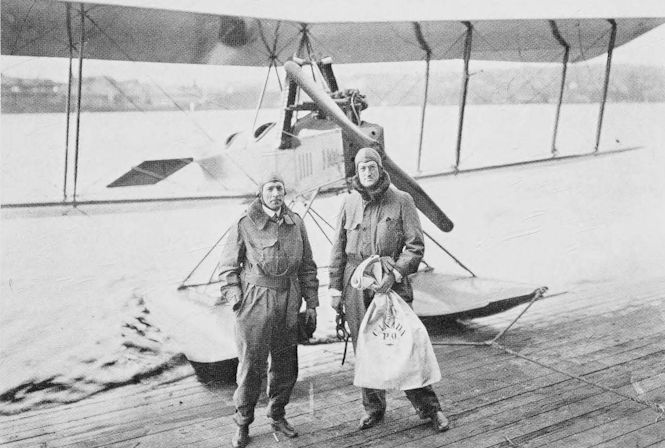
On 3 March, 1919, Edward Hubbard (left) and William Boeing made a survey flight with mail, from Vancouver to Seattle, in a Boeing C-700. They are seen in front of the seaplane on arrival at Seattle.
The First Steps
Eddie Hubbard’s Airline
<...>
After a series of trials in July 1920, Hubbard began a regular air mail service on 15 October of that year, from Seattle to Victoria, connecting with the Japanese ship Africa Maru. The 84 miles were covered in 50 min by a Boeing B-1, the first commercial design of the Boeing Airplane Company. Operated as a private contract mail service under U.S. Post Office foreign mail appropriations, the main purpose was to gain a few extra hours for the mails by connecting with the first landfall made by the ship. The contract called for a maximum of twelve round trips per month, with maximum loads of 600 Ib per trip. Between 25,000 and 50,000 lb of mail were flown annually by Eddie Hubbard’s airline, or the Seattle - Victoria Air Mail Line, as it became known.
Hubbard was later to join with Boeing in more ambitious airline ventures when he became a director of Boeing Air Transport, but his original route was flown continuously under other names and in other hands until 30 June, 1937, completing almost 17 years of continuous operation.
Eddie Hubbard’s Airline
<...>
After a series of trials in July 1920, Hubbard began a regular air mail service on 15 October of that year, from Seattle to Victoria, connecting with the Japanese ship Africa Maru. The 84 miles were covered in 50 min by a Boeing B-1, the first commercial design of the Boeing Airplane Company. Operated as a private contract mail service under U.S. Post Office foreign mail appropriations, the main purpose was to gain a few extra hours for the mails by connecting with the first landfall made by the ship. The contract called for a maximum of twelve round trips per month, with maximum loads of 600 Ib per trip. Between 25,000 and 50,000 lb of mail were flown annually by Eddie Hubbard’s airline, or the Seattle - Victoria Air Mail Line, as it became known.
Hubbard was later to join with Boeing in more ambitious airline ventures when he became a director of Boeing Air Transport, but his original route was flown continuously under other names and in other hands until 30 June, 1937, completing almost 17 years of continuous operation.
The United States Air Mail Service
New York - Washington
The individual stories of the small airlines which survived precariously during the first few years after the Great War were colourful, almost romantic. They resulted from the efforts of determined promoters who sought to exploit the aeroplane as a transport vehicle in its own right. Sadly, their efforts were frustrated by the inadequacies of the material at their disposal. Few aircraft were reliable enough; operational facilities of such basic importance as good aerodromes were almost non-existent; the public had been nurtured on a diet of hair-raising stories of war exploits which aimed to emphasize the thrills involved in handling temperamental heavier-than-air machines. First-hand experience of these was gleaned from visiting barnstormers, pilots who offered a circus-like show of stunt-flying which served only to confirm the public’s attitude of doubt. Not surprisingly, therefore, the little would-be airlines were unsuccessful in persuading enough people to pay enough money for a long enough period to support aircraft which, being the products of an infant industry, were hopelessly uneconomic. Indeed, the total output of all the small airlines which tried to operate without a subsidy of some kind was quite insignificant compared with the figures set up by the U.S. Air Mail Service.
In 1916, funds were made available for payment for the carriage of mail by aeroplane from the appropriation for Steamboat or Other Power Boat Service. Advertisements were issued inviting bids for a route in Massachusetts and several in Alaska; but none were taken up because at that time neither aircraft nor landing grounds were available, and the number of pilots in the entire U.S.A. was very small. However, the rapid development of aircraft manufacture and flying techniques stimulated by the war encouraged the Post Office to persist in its belief that an air mail service was a practical possibility.
Accordingly, when the Post Office received for the fiscal year ending 30 June, 1918, an appropriation of $100,000. for an experimental air service, it turned thought into action. Late in 1917 bids were requested from aircraft manufacturers for the construction of five mailplanes. Three bids were received, opened on 21 February, 1918, accepted, and delivery promised in 90 days. By modern standards, this would not seem to give cause for impatience, but the Post Office Department had the bit firmly between its teeth and eagerly took up a suggestion by Col E. A. Deeds (later to become one of the chief organizers of United Air Transport) that the Army might furnish aircraft on a temporary basis so as to advance the inauguration date. The offer was accepted and the events which followed epitomized the nature of air operations in the United States in 1918, reflecting the vision of the promoters, their zeal in setting praiseworthy targets, and the haphazard means at their disposal to achieve their goals.
On 13 May, 1918, the Army officers who had been assigned to carry the mail were informed that their aeroplanes had arrived at Belmont Park, Long Island, ready for assembly. By the afternoon of the next day, two aircraft were actually completed and flown to Philadelphia, and one of them flew on to Washington on the 15th. At noon, President Woodrow Wilson came with members of his cabinet to the Polo Grounds to give the Postmaster General, Albert S. Burleson, his blessing at the inaugural ceremony.
Overcoming a slight delay caused by the absence of fuel in the tanks, the pilot took-off and followed railway tracks which he believed would lead him to New York - and was next heard of at a farm in southern Maryland. Fortunately for the official records, the service in the other direction was performed according to plan, which included a change of aircraft at Philadelphia. Lieuts Torrey Webb and J. C. Edgerton were the successful pilots, flying Curtiss JN-4Hs. The total elapsed time, New York - Washington, was 3 hr 20 min.
The standards of navigation when the Post Office Mail service opened on 15 May, 1918, were primitive in the extreme. Dr E. P. Warner recalls: ‘On the third day of the service, the same pilot who had failed to find Philadelphia from Washington in his first attempt tried again. This time he was given careful directions by landmark to Baltimore, and instructions thereafter simply to keep Chesapeake Bay on his right; instructions which he followed with such sedulous attention to detail that he reached the northern end of the bay, followed the water around the end and down the eastern side, still keeping it always on his right, and landed in Cape Charles on making the discovery that he was out of fuel and that the water now was not only on his right, but on his left and in front of him as well, and that only a narrow strip of land lay behind.’
In spite of early shortcomings such as this, however, the pilots learned quickly and the U.S. Aerial Mail Service, as it was designated officially, settled down to a fair record of punctuality and regularity, averaging 91 per cent completion of its scheduled flights during 1918. Initial public response was not exactly enthusiastic, however. The rate charged when the service started was 24c per ounce, including 10c special delivery, compared with 3c for ordinary deliveries and 10c for express; and the time saved compared with surface means was not substantial.
<...>
New York - Washington
The individual stories of the small airlines which survived precariously during the first few years after the Great War were colourful, almost romantic. They resulted from the efforts of determined promoters who sought to exploit the aeroplane as a transport vehicle in its own right. Sadly, their efforts were frustrated by the inadequacies of the material at their disposal. Few aircraft were reliable enough; operational facilities of such basic importance as good aerodromes were almost non-existent; the public had been nurtured on a diet of hair-raising stories of war exploits which aimed to emphasize the thrills involved in handling temperamental heavier-than-air machines. First-hand experience of these was gleaned from visiting barnstormers, pilots who offered a circus-like show of stunt-flying which served only to confirm the public’s attitude of doubt. Not surprisingly, therefore, the little would-be airlines were unsuccessful in persuading enough people to pay enough money for a long enough period to support aircraft which, being the products of an infant industry, were hopelessly uneconomic. Indeed, the total output of all the small airlines which tried to operate without a subsidy of some kind was quite insignificant compared with the figures set up by the U.S. Air Mail Service.
In 1916, funds were made available for payment for the carriage of mail by aeroplane from the appropriation for Steamboat or Other Power Boat Service. Advertisements were issued inviting bids for a route in Massachusetts and several in Alaska; but none were taken up because at that time neither aircraft nor landing grounds were available, and the number of pilots in the entire U.S.A. was very small. However, the rapid development of aircraft manufacture and flying techniques stimulated by the war encouraged the Post Office to persist in its belief that an air mail service was a practical possibility.
Accordingly, when the Post Office received for the fiscal year ending 30 June, 1918, an appropriation of $100,000. for an experimental air service, it turned thought into action. Late in 1917 bids were requested from aircraft manufacturers for the construction of five mailplanes. Three bids were received, opened on 21 February, 1918, accepted, and delivery promised in 90 days. By modern standards, this would not seem to give cause for impatience, but the Post Office Department had the bit firmly between its teeth and eagerly took up a suggestion by Col E. A. Deeds (later to become one of the chief organizers of United Air Transport) that the Army might furnish aircraft on a temporary basis so as to advance the inauguration date. The offer was accepted and the events which followed epitomized the nature of air operations in the United States in 1918, reflecting the vision of the promoters, their zeal in setting praiseworthy targets, and the haphazard means at their disposal to achieve their goals.
On 13 May, 1918, the Army officers who had been assigned to carry the mail were informed that their aeroplanes had arrived at Belmont Park, Long Island, ready for assembly. By the afternoon of the next day, two aircraft were actually completed and flown to Philadelphia, and one of them flew on to Washington on the 15th. At noon, President Woodrow Wilson came with members of his cabinet to the Polo Grounds to give the Postmaster General, Albert S. Burleson, his blessing at the inaugural ceremony.
Overcoming a slight delay caused by the absence of fuel in the tanks, the pilot took-off and followed railway tracks which he believed would lead him to New York - and was next heard of at a farm in southern Maryland. Fortunately for the official records, the service in the other direction was performed according to plan, which included a change of aircraft at Philadelphia. Lieuts Torrey Webb and J. C. Edgerton were the successful pilots, flying Curtiss JN-4Hs. The total elapsed time, New York - Washington, was 3 hr 20 min.
The standards of navigation when the Post Office Mail service opened on 15 May, 1918, were primitive in the extreme. Dr E. P. Warner recalls: ‘On the third day of the service, the same pilot who had failed to find Philadelphia from Washington in his first attempt tried again. This time he was given careful directions by landmark to Baltimore, and instructions thereafter simply to keep Chesapeake Bay on his right; instructions which he followed with such sedulous attention to detail that he reached the northern end of the bay, followed the water around the end and down the eastern side, still keeping it always on his right, and landed in Cape Charles on making the discovery that he was out of fuel and that the water now was not only on his right, but on his left and in front of him as well, and that only a narrow strip of land lay behind.’
In spite of early shortcomings such as this, however, the pilots learned quickly and the U.S. Aerial Mail Service, as it was designated officially, settled down to a fair record of punctuality and regularity, averaging 91 per cent completion of its scheduled flights during 1918. Initial public response was not exactly enthusiastic, however. The rate charged when the service started was 24c per ounce, including 10c special delivery, compared with 3c for ordinary deliveries and 10c for express; and the time saved compared with surface means was not substantial.
<...>
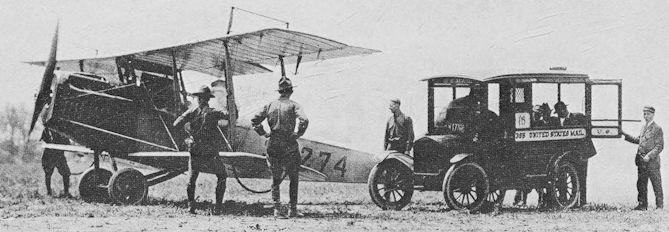
Mail being transferred to an Army Curtiss JN-4H operating on the U.S. Aerial Mail Service. This type was one of the famous ‘Jenny’ series and the example illustrated bore serial number 38274.
The First Steps
Aeromarine
Many answered the call; few were chosen. Once the returning aviators, fresh from military adventures in Europe, had looked around and found their bearings, a number of enterprises associated with the general theme of starting an air service were announced in many parts of the U.S.A., mainly on the coast. Only a few of these, however, made actual flights with fare-paying passengers, and still less made any pretence at operating to a schedule. One was a company called Aero Ltd, which made a series of flights in August 1919 between New York and Atlantic City, using warsurplus HS-2 flying-boats, and, shortly afterwards, Florida West Indies Airways Inc operated some services in the Caribbean.
The stimulus in this latter area was the introduction by Congress of the Prohibition Act, which became effective on 30 June, 1919. The consumption of alcohol became a criminal offence in every bar or restaurant under the United States flag but did not apply to foreign territories such as Cuba or the Bahamas, which lay temptingly 100 miles offshore from Florida. Showing considerable elan and initiative, Aero Ltd promptly flew its aircraft south and is reported to have made 40 round trips from Miami to Nassau to satisfy the needs of thirsty Americans.
These tentative operations were quickly superseded by those of Aeromarine Airways Inc, founded as a subsidiary of the Aeromarine Plane and Motor Corporation of Keyport, New Jersey. Aeromarine was backed by Inglis M. Uppercu, formerly a New York motorcar distributor, who had built seaplanes for the Navy during the war. His pilots included Durston Richardson, and Ed Musick, who later became one of Pan American Airways’ famous Clipper Commanders.
During the war, the United States armed services had developed a system of aircraft procurement in which the winner of a design competition sold not only his design but also the manufacturing rights. Thus, for example, Curtiss’ original HS-2 coastal patrol flying-boat, sold to the Navy, was then built by other manufacturers, notably Boeing. When the war ended, the newly-formed Manufacturers Aircraft Association suggested to the Army and Navy that aircraft should be sold gradually, through private companies, under strict government supervision, to avoid glutting the market.
The idea was readily accepted and Aeromarine was one of the beneficiaries, converting HS-2s (which had cost the Navy $18,000 each) to six-passenger flying-boats, either with an open cockpit or with a transparent hood in the luxury model. These were sold to customers for $6,000 to $9,000 each, but, more important, were also employed by the airline subsidiary.
<...>
Between 7 July and 11 September, 1921, an Aeromarine HS-2 made a special flight from New York to Chicago and back, via the Hudson River, Lake George, Lake Champlain, the St Lawrence River and four of the Great Lakes, to win the Glidden Trophy for setting up a world record flight for commercial flying-boats of over 7,000 miles. The average speed was 73-5 mph for an actual flying time of only 102 hr and there was not a single delay caused by any mechanical failure.
<...>
Routes to Santa Catalina
<...>
At the end of 1920, Pacific Marine Airways was organized by Foster Curry, a vacation promoter from Yosemite. Operations began from Wilmington, opposite San Pedro, to Avalon, using two Curtiss HS-2Ls, until 29 June, 1928, when Western Air Express took over the company.
Aeromarine
Many answered the call; few were chosen. Once the returning aviators, fresh from military adventures in Europe, had looked around and found their bearings, a number of enterprises associated with the general theme of starting an air service were announced in many parts of the U.S.A., mainly on the coast. Only a few of these, however, made actual flights with fare-paying passengers, and still less made any pretence at operating to a schedule. One was a company called Aero Ltd, which made a series of flights in August 1919 between New York and Atlantic City, using warsurplus HS-2 flying-boats, and, shortly afterwards, Florida West Indies Airways Inc operated some services in the Caribbean.
The stimulus in this latter area was the introduction by Congress of the Prohibition Act, which became effective on 30 June, 1919. The consumption of alcohol became a criminal offence in every bar or restaurant under the United States flag but did not apply to foreign territories such as Cuba or the Bahamas, which lay temptingly 100 miles offshore from Florida. Showing considerable elan and initiative, Aero Ltd promptly flew its aircraft south and is reported to have made 40 round trips from Miami to Nassau to satisfy the needs of thirsty Americans.
These tentative operations were quickly superseded by those of Aeromarine Airways Inc, founded as a subsidiary of the Aeromarine Plane and Motor Corporation of Keyport, New Jersey. Aeromarine was backed by Inglis M. Uppercu, formerly a New York motorcar distributor, who had built seaplanes for the Navy during the war. His pilots included Durston Richardson, and Ed Musick, who later became one of Pan American Airways’ famous Clipper Commanders.
During the war, the United States armed services had developed a system of aircraft procurement in which the winner of a design competition sold not only his design but also the manufacturing rights. Thus, for example, Curtiss’ original HS-2 coastal patrol flying-boat, sold to the Navy, was then built by other manufacturers, notably Boeing. When the war ended, the newly-formed Manufacturers Aircraft Association suggested to the Army and Navy that aircraft should be sold gradually, through private companies, under strict government supervision, to avoid glutting the market.
The idea was readily accepted and Aeromarine was one of the beneficiaries, converting HS-2s (which had cost the Navy $18,000 each) to six-passenger flying-boats, either with an open cockpit or with a transparent hood in the luxury model. These were sold to customers for $6,000 to $9,000 each, but, more important, were also employed by the airline subsidiary.
<...>
Between 7 July and 11 September, 1921, an Aeromarine HS-2 made a special flight from New York to Chicago and back, via the Hudson River, Lake George, Lake Champlain, the St Lawrence River and four of the Great Lakes, to win the Glidden Trophy for setting up a world record flight for commercial flying-boats of over 7,000 miles. The average speed was 73-5 mph for an actual flying time of only 102 hr and there was not a single delay caused by any mechanical failure.
<...>
Routes to Santa Catalina
<...>
At the end of 1920, Pacific Marine Airways was organized by Foster Curry, a vacation promoter from Yosemite. Operations began from Wilmington, opposite San Pedro, to Avalon, using two Curtiss HS-2Ls, until 29 June, 1928, when Western Air Express took over the company.
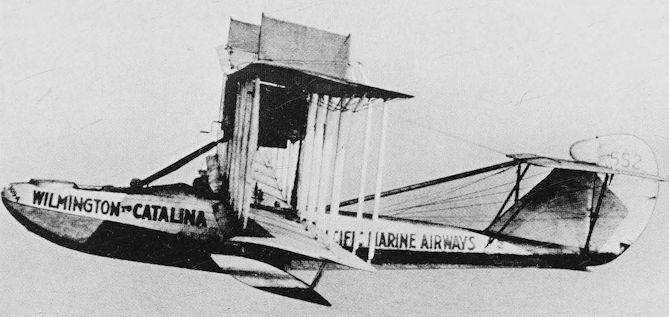
One of the two Curtiss HS-2L flying-boats used on the Wilmington - Catalina service of Pacific Marine Airways.
The First Steps
Routes to Santa Catalina
Compared with the Post Office Mail, the Model Airway, Aeromarine, and the two contract foreign mail carriers, other airline operations during the first few post-war years were minute. One company deserves mention, however, possibly because the route it started has been operated more or less continuously ever since by an assortment of airlines ranging from trunk carriers to air taxi firms.
On 4 July, 1919, Syd Chaplin Airlines began services from San Pedro (in the port district of Los Angeles) on a 34-mile route to Avalon (the resort on the island of Santa Catalina), using one Curtiss MF flying-boat, which, incidentally, was shipped from the factory on Long Island by Railway Express. The company operated three round trips per day, exactly the same number as the total staff, and became known as Catalina Airlines.
Regular service ended on 15 September, after less than three months of operations, and although one of the pilots continued to make flights on demand, these too ended the following year.
<...>
Routes to Santa Catalina
Compared with the Post Office Mail, the Model Airway, Aeromarine, and the two contract foreign mail carriers, other airline operations during the first few post-war years were minute. One company deserves mention, however, possibly because the route it started has been operated more or less continuously ever since by an assortment of airlines ranging from trunk carriers to air taxi firms.
On 4 July, 1919, Syd Chaplin Airlines began services from San Pedro (in the port district of Los Angeles) on a 34-mile route to Avalon (the resort on the island of Santa Catalina), using one Curtiss MF flying-boat, which, incidentally, was shipped from the factory on Long Island by Railway Express. The company operated three round trips per day, exactly the same number as the total staff, and became known as Catalina Airlines.
Regular service ended on 15 September, after less than three months of operations, and although one of the pilots continued to make flights on demand, these too ended the following year.
<...>
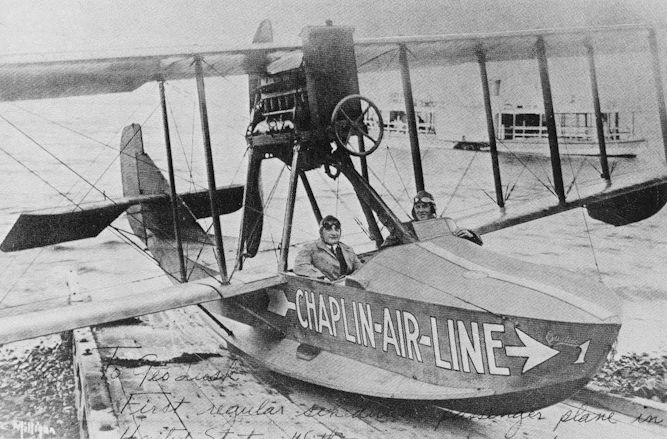
The Curtiss MF flying-boat used in 1919 to operate Syd Chaplin Airlines’ San Pedro (Los Angeles) - Avalon (Santa Catalina) service.
The United States Air Mail Service
New York - Washington
<...>
On 12 August, 1918, the Post Office took over the service, under the command of Capt Benjamin B. Lipsner, who had been concerned with running the mail service under Army direction and resigned his commission to take over. The Washington terminal was moved to College Park, in Maryland, and seven biplanes, built specially by the Standard Aircraft Corporation, were placed into service. Each could carry 300 Ib of mail and cruise at 90 mph. On 15 July, 1918, the rate was reduced to 16c per ounce plus 6c for each additional ounce, including 10c special delivery charge; then, on 15 December, 1918, the rate was reduced to 6c per ounce, without special delivery, and eventually, on 18 July, 1919, to the standard rate of 2c. But the service did not prosper, mainly because of the inability of the Post Office to demonstrate a convincing case over a distance as short as 220 miles.
The New York - Philadelphia - Washington route served, however, as a training ground for a far more ambitious project, and by the time the service closed down, on 31 May, 1921, for reasons of economy, the transcontinental air mail was well into its stride.
New York - Washington
<...>
On 12 August, 1918, the Post Office took over the service, under the command of Capt Benjamin B. Lipsner, who had been concerned with running the mail service under Army direction and resigned his commission to take over. The Washington terminal was moved to College Park, in Maryland, and seven biplanes, built specially by the Standard Aircraft Corporation, were placed into service. Each could carry 300 Ib of mail and cruise at 90 mph. On 15 July, 1918, the rate was reduced to 16c per ounce plus 6c for each additional ounce, including 10c special delivery charge; then, on 15 December, 1918, the rate was reduced to 6c per ounce, without special delivery, and eventually, on 18 July, 1919, to the standard rate of 2c. But the service did not prosper, mainly because of the inability of the Post Office to demonstrate a convincing case over a distance as short as 220 miles.
The New York - Philadelphia - Washington route served, however, as a training ground for a far more ambitious project, and by the time the service closed down, on 31 May, 1921, for reasons of economy, the transcontinental air mail was well into its stride.
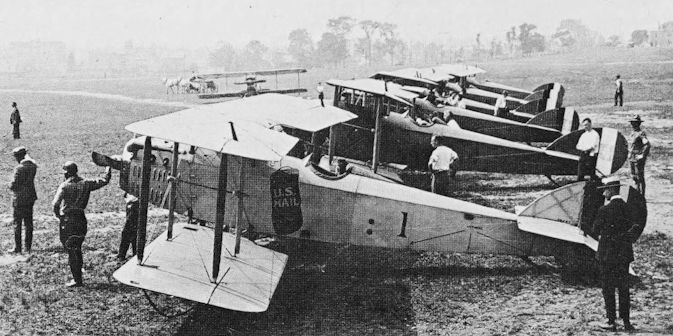
Among the Post Office’s 1918 fleet were seven standard JR-1B single-engined biplanes. All seven are seen in this photograph taken in August 1918. The three nearest aircraft bear numbers 1, 4 and 2 and the fifth from the front is No. 5.